
Precision Problem Solvers: The Science of Pharmaceutical Compounding
In an era of standardized healthcare, modern medicine often operates on averages—average bodies, typical tolerances, and standard therapeutic needs. Yet, patients are rarely “average.” When commercially available medications fail to meet the unique requirements of a specific patient, there is a critical gap in care.
This is where pharmaceutical compounding enters the frame.
Compounding is the intersection of rigorous science and bespoke craftsmanship. It is the practice of creating customized medications from raw ingredients to meet the exact needs of an individual—human or animal. Compounding pharmacists and technicians are the problem-solvers of the medical world, utilizing advanced knowledge of chemistry and physiology to create therapies that simply do not exist on pharmacy shelves.
The Two Arenas of Compounding: Sterile & Non-Sterile
The preparation of these custom medications is rigorously segregated into two distinct disciplines, each governed by profound differences in environmental control and risk.
🩺 Sterile Compounding
This is the apex of pharmaceutical preparation, demanding an environment of absolute purity. Sterile compounding is reserved for medications that will be introduced directly into the body’s most sensitive areas, bypassing its natural defenses. The slightest microbial contamination could be catastrophic.

- What it is: The aseptic formulation of drugs within the confines of an ISO-classified “cleanroom.” These rooms use HEPA-filtered air and strict, complex protocols to ensure the final product is completely free of microorganisms.
- Common Applications:
- Injectables: Custom-dosed medications for intravenous (into the vein), intramuscular, or subcutaneous (under the skin) injection.
- Ophthalmic Preparations: Bespoke eye drops and ointments for post-surgical care or treating complex eye infections, where sterility is non-negotiable.
🩹 Non-Sterile Compounding
This category encompasses all other custom formulations. While not required to be sterile, these preparations are crafted with extreme precision in a dedicated, controlled laboratory environment to ensure purity, potency, and safety.
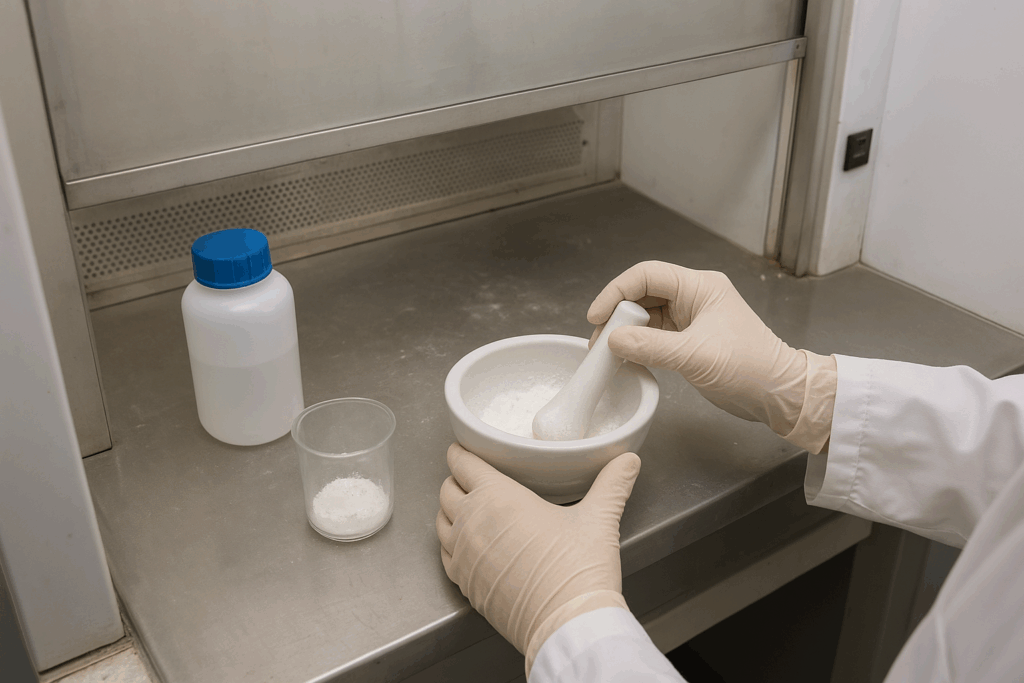
- What it is: The meticulous mixing, blending, or reformulation of ingredients to create medications that are typically taken orally or applied externally.
- Common Applications:
- Custom-strength capsules or suppositories.
- Flavored oral suspensions and powders.
- Topical and transdermal creams, gels, and ointments.
The Formulation Toolkit: Engineering the Solution
A compounder’s true expertise is revealed in their ability to select and create the ideal dosage form to overcome a specific therapeutic challenge.
- Precision Dosing: For pediatric and neonatal patients, this is a critical function. A compounder can prepare a stable, palatable oral liquid with a precise dose (e.g., 1.25 mg/mL), allowing for safe and accurate administration to a “little one” based on their specific weight, something impossible to achieve by splitting a commercial tablet.
- Topical vs. Transdermal Delivery: This distinction is key to sophisticated therapy.
- Topicals: These formulations (creams, ointments) are designed to act locally on the surface of the skin or just below it, such as an anti-inflammatory for a specific joint or a custom scar cream.
- Transdermals: These are highly advanced gels or patches engineered with specific penetration enhancers. Their goal is to drive the active drug through the skin and into the bloodstream for a systemic effect, providing an invaluable alternative for patients who cannot take medication orally.
- Alternative Routes: For patients with swallowing difficulties, a compounder can formulate:
- Troches: Small, flavored lozenges that dissolve between the cheek and gum.
- Suppositories: A highly effective route when oral administration is not an option.
The Impact: Solving Problems for Humans and Animals
This ability to customize therapy is an essential, problem-solving component of modern healthcare.
For Human Patients
A compounding pharmacy acts as a vital resource for physicians facing complex cases.
- Problem: Allergen & Excipient Sensitivity. A patient is allergic to the gluten filler in their essential thyroid medication.
- Solution: The compounder formulates capsules using the pure thyroid hormone and a hypoallergenic filler, like microcrystalline cellulose.
- Problem: Therapeutic Gaps. A commercially available drug is discontinued for economic reasons, leaving patients without a treatment.
- Solution: A compounder can frequently, and legally, recreate that specific formulation to ensure continuity of care.
- Problem: Route of Administration. A hospice patient in palliative care can no longer swallow their pain medication.
- Solution: The pharmacist collaborates with the prescriber to compound the medication into a transdermal gel that can be applied to the skin for systemic relief.
🐾 For Veterinary Patients
The need for compounding is even more profound in veterinary medicine. The vast majority of FDA-approved drugs are designed for humans, creating a significant therapeutic gap for animals.
- Problem: Interspecies Dosing. A 1,200-pound horse and a 4-pound rabbit cannot take the same medication.
- Solution: The compounder prepares the exact dose needed for that species and weight, often in a form like an oral paste for the horse or a tiny, flavored liquid for the rabbit.
- Problem: Palatability & Compliance. A cat needs a daily heart medication but foams at the mouth and hides from the bitter-tasting pill.
- Solution: The pharmacist reformulates the drug into a chicken- or fish-flavored liquid or, in some cases, a transdermal gel that the owner can simply rub into the hairless skin of the cat’s ear.
In essence, pharmaceutical compounding is the bridge between the standardized world of drug manufacturing and the unique reality of the individual patient. It is a precise, indispensable discipline that provides answers when mass-produced medicine simply cannot.